The FHE Revolution
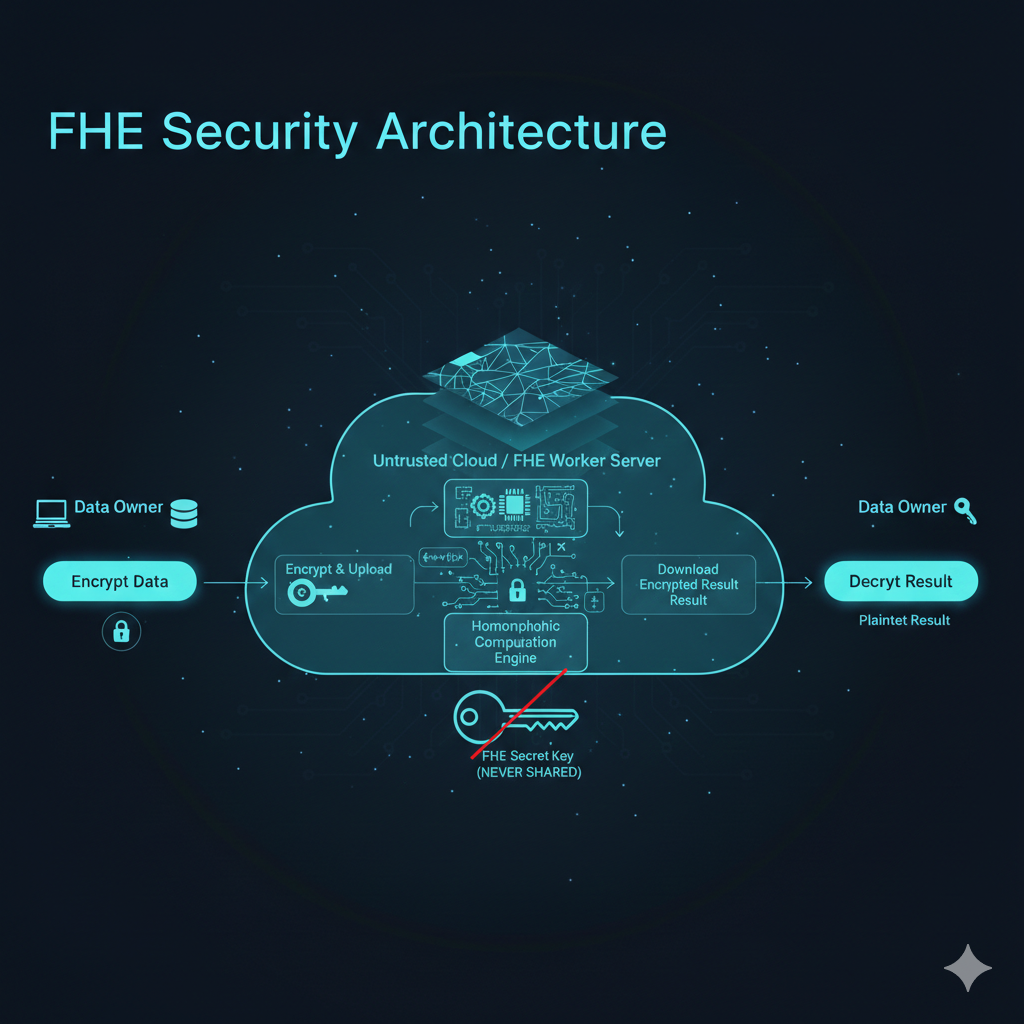
Fully Homomorphic Encryption (FHE) is the "holy grail" of cryptography. It enables third parties to perform mathematical operations on encrypted data without ever having access to the decryption key.
By leveraging advanced lattice-based cryptography, FHE eliminates the trade-off between data utility and data privacy, allowing secure outsourcing of workloads to untrusted cloud environments.

Technical Core Functionalities
Lattice-Based Security
Built upon the Ring Learning with Errors (RLWE) problem, providing post-quantum resistance and a robust mathematical foundation for secure parameter generation.
Ciphertext Maintenance
Advanced bootstrapping and noise management techniques allow for "deep" circuits, enabling virtually unlimited consecutive multiplications and additions.
Optimized Arithmetic
Support for both bitwise operations (CGGI/TFHE styles) and integer/vectorized arithmetic (BGV/BFV schemes) to suit diverse computational needs.
Hardware Acceleration
Architected to leverage AVX-512, HEXL-based optimizations, and multi-threading to bridge the performance gap associated with homomorphic workloads.
Modular Abstraction
A clean API design that abstracts away complex polynomial mathematics, allowing developers to focus on high-level logic and data flow.
SIMD Operations
Single Instruction, Multiple Data (SIMD) packing allows for processing large vectors of data in a single homomorphic operation, drastically increasing throughput.
Security & Privacy Framework
Zero-Trust Computation
The framework ensures that the "Worker" node never possesses the secret key. Even if the server environment is compromised, the underlying data remains a mathematically opaque ciphertext.
Key Management
Support for sophisticated threshold cryptography and public-key infrastructure, ensuring that decryption capability is restricted based on rigorous policy.
High-Value Use Cases
Searchable Encryption
Enables servers to perform keyword matching and search queries on encrypted data without decryption, retrieving relevant results while preserving absolute privacy.
Private Genomic Research
Analyze patient DNA for markers of disease while keeping the raw genetic sequence encrypted, ensuring absolute patient anonymity during the research process.
Confidential Finance
Perform multi-party risk assessments or credit scoring across different banking entities without exposing individual account details or trade secrets.